Ir al contenido

Gaceta Asgardiana

Nuestro camino como asgardianos, un reto que sigue adelante

  • comites
  • parlamento
  • dialogo
  • lideres
  • La importancia de nuestras comunidades en la página web oficial
  • Forma parte de Asgardia
  • De las naciones del mundo a la unidad de la humanidad
  • Difundir y compartir uno de los grandes motivos de estar aquí

Día: 11 de abril de 2026

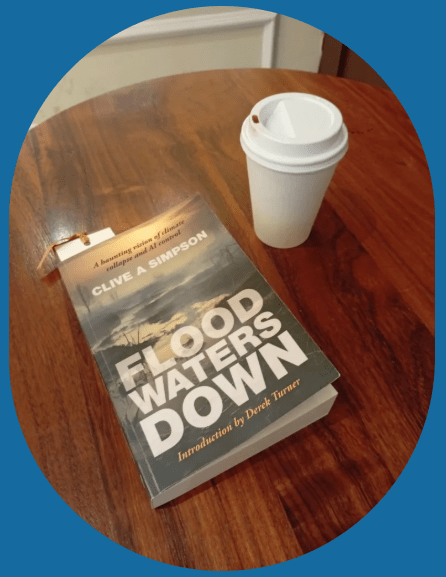
Finding Order in Chaos: A Review of the Work Flood Waters Down by the Writer Clive Simpson

Avatar de Ariadne Gallardo Figueroa

by Ariadne Gallardo Figueroa

Discovering Clive Simpson’s work through his pre-presentation book has been a unique experience, especially for someone who usually writes in Spanish. His work raises numerous questions and reveals shocking surprises, but I must focus on one in particular: Is anarchy inevitable? Should we submit and accept what the future holds? These are unsettling questions that come to mind as I explore his work; I walk hand in hand with the woman who steers the ship, whose firm voice resonates in my thoughts as I reflect on the course of our society.

As we move forward, I realize that the uncertainty surrounding us is a mirror of our doubts and fears, posing an existential dilemma about order and chaos.

History seems to repeat itself, with cycles of frustration and hope marking the rhythm of our days, challenging us to find a balance between what we desire and what we fear. The horizon presents itself as a blank canvas, waiting to be painted with our dreams or our nightmares.

The magic a writer creates for their reader is that we can step into the shoes of each character, feel them as the essence of something that compels us to see ourselves reflected in them. Thus, we resonate with the scenes unfolding before our eyes. As we read, we become immersed in a plot that makes time and space lose their relevance, taking our thoughts to a place where the boundaries between fiction and reality blur. We can even imagine the annoying buzzing of mosquitoes that distract and frighten us with more than just their bite, feeling their presence almost tangible, like a shadow lurking in the darkness. We find ourselves in a vivid landscape, where each written word transforms the air we breathe into a sensation filled with emotions and memories, making us part of the story that unfolds with each new page.
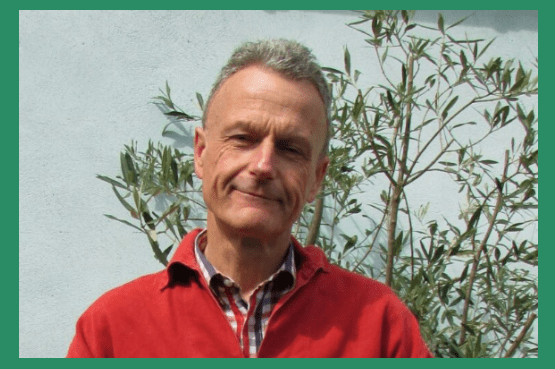
The opening pages invite us to explore Derek Turner‘s thinking. The invaluable contribution of the Irish journalist Turner, with his vast experience and knowledge, brings a unique perspective. His participation in the introduction has enriched the literary project, offering thought-provoking insights and highlighting how the author leads us to a logical conclusion considering contemporary trends.
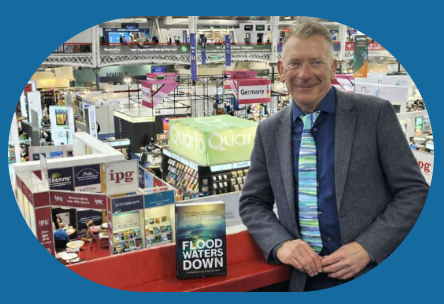
The book in its previous format has visited, along with its author, different spaces that will become venues where the work can be discovered by the eager curiosity of its readers.

Upon encountering this important work, the question that immediately arises is whether, as humanity, we need a leviathan in the deep waters…

Hobbes’s Leviathan theory imposes the unsettling idea that the State must be established as an absolute power, a necessary tyrant to prevent the unbridled chaos of the state of nature. Human existence would be reduced to a solitary, miserable, disgusting, brutal, and tragically brief struggle.

But what happens when there is a power that does not emanate from what the State establishes, but from everything that money and its cover allow?

The author is a man born under the sign of Pisces, and this reminds me that his environment called him to get involved in this story. Not because of his birth sign, but because of his commitment to the reality he inhabits daily.

In all of this, the fact that a writer is of this nature leads me to think of his profound research, of the cautious yet incisive gaze with which he discovers the glimmer of a detail. The environment as a drama that deserves to be brought to light and not remain in the profound silence of the floodwaters.

This commitment is evident not only in his stories but in every observation he makes, where he transforms the everyday into prose and the trivial into life lessons. Each word he chooses resonates with the power of his introspection, capturing the essence of the human experience in his writing, making the reader not only witness the story but become a part of it. Thus, his work becomes a bridge connecting the deepest emotions with the fragility of existence, challenging the reader to reflect on their reality while navigating the currents of the author’s soul.

Where can we observe the collective body of thousands of wills to which Hobbes refers? As an English philosopher, I can certainly focus on the scenes of an author who is also English and carries in his blood the genetic makeup that has woven the history of his nation.
Human beings, driven by distrust, competition, and glory, are visualized within Tulip Haven, a space that desperately tries to maintain an environment created for its dreams. A fragile environment where a handful of individuals seemingly transfer power to a common authority.…

In this sense, a prominent concept emerges that has impacted all of us to a greater or lesser extent: the incursion of artificial intelligence into the activities that we entrust to security, technology, and our future.

This phenomenon has transformed not only how we interact with machines, but also how we perceive the world around us. What we once considered a mere tool has evolved into an active participant in our daily lives, affecting everything from our simplest to our most complex decisions.

In this context, it is essential to reflect on what we give to the world and what lies hidden in the fragile reality that sustains us. Every technological advance brings not only benefits, but also ethical and existential challenges that we must face.

I arrive at that space where a vital character enjoys her drink and for her nothing is impossible, even above the predictions of her reality embodied in the figure of artificial intelligence.

Pages more or less, she returns and is observed with that power that does not recognize errors; the superiority of a finely tuned mind that has allied itself with the machine that cannot be less than she.

I keep reading, and I wonder: how much will we have to adapt to these changes, and what does it depend on? Undoubtedly, when one of the characters in “The Ark” warns:Learning to make allies as social beings is fundamental. Then I reflect that perhaps it is too late to avoid what nature shows us at every moment, but it is precisely in what nature itself points out that we will be able to understand what step we must take.

One of the most important people in Clive’s life is undoubtedly his wife, Margaret. I’m truly interested in knowing her opinion of Clive Simpson’s work. I often picture her in their garden, listening from afar as her husband types on his computer, and occasionally, he calls her over to share a paragraph or a chapter. She arrives smiling, setting aside her gardening tools to sit beside him and listen to what he has to say. Her attention to her husband’s work is a breath of fresh air, that spark where the work feels supported by her sincere and objective observation. Margaret. Her reflections are fundamental to me.

In response to my question, she answered me: 
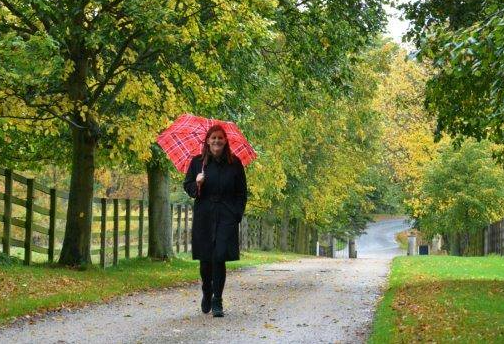
Hi Ariadne, I hope you’re well and had a good day. It’s been sunny here, which is unusual! I’ve been busy gardening, one of my greatest passions.

So here I am, trying to figure out what to tell you about my thoughts on Flood Waters Down. For me, Clive manages to create a real sense of place; we both grew up in the marshland landscape, with its vast plains and skies.

One grows up aware of the importance of the weather and tides in this environment. Clive also expresses the breakdown of society, community, and relationships. However, a thread of hope runs through the story: while some seek to destroy society and the environment for their gain, others seek to unite and resist, adapting to the inevitable changes brought about by climate change.

I’ve seen Clive work tirelessly to craft his story, making it relatable and thought-provoking. He brings to life one of the many scenarios we could face in the future. I hope people connect with the landscape and characters, and enjoy reading Flood Waters Down. Kind regards, Margaret. 

I greatly appreciated your comments, and I thoroughly agree with your perspective on your beloved husband’s work.

Then I continue reviewing the paragraphs I have read and reflect:

Generally, at the end of our lives we hope that what we have managed to achieve will allow us to live with the confidence of security. We want to preserve the health we have left, and receive adequate care for a dignified old age.… The work hits the nail on the head and urges us to reflect on the path we have chosen as humanity, where the future is uncertain. None of the inhabitants of this planet could deny the fragility that resides within us.

We are actors on a stage where we build the structure that inspires us and protects us from everything we are as humanity, and from what could go wrong. It is under the monitoring of predictions and figures that observe the future, which make us part of history.
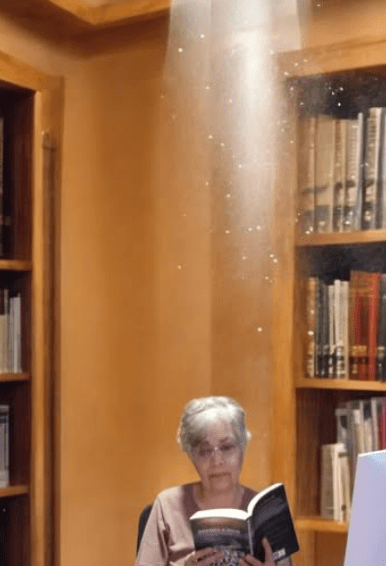
A beam of light shines toward the stars, revealing a path that could be a legacy in the face of an uncertain future. You’ll have to read the book to find out what I mean.
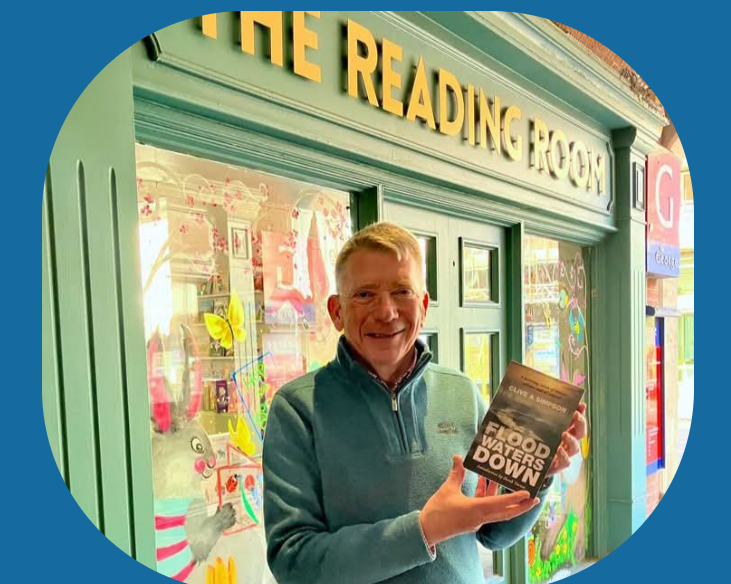
The Reading Room is a popular independent bookshop in Grantham that opened in February 2025. It has quickly become a community hub, recently winning Independent Retailer of the Year at the Grantham Business Awards. A welcoming space offering a carefully curated selection of titles, it’s also where visitors to The George Centre in Grantham, UK, will find the work of Clive A Simpson.

Flood Waters Down Book By Clive A Simpson, (Kobo eBook) | Indigo

Flood Waters Down by Clive A Simpson | eBook | Barnes & Noble®

Flood Waters Down | Waterstones

Clive Simpson and his ecological novel «Flood Waters …

Flood Waters Down – porrua.mx

Flood Waters Down | Cliftop Publishing

Tu voto:

Comparte esto:

  • Compartir en X (Se abre en una ventana nueva) X
  • Comparte en Facebook (Se abre en una ventana nueva) Facebook
  • Compartir en LinkedIn (Se abre en una ventana nueva) LinkedIn
  • Compartir en Tumblr (Se abre en una ventana nueva) Tumblr
  • Compartir en Telegram (Se abre en una ventana nueva) Telegram
  • Enviar un enlace a un amigo por correo electrónico (Se abre en una ventana nueva) Correo electrónico
Me gusta Cargando...
Avatar de DesconocidoAutor Ariadne Gallardo FigueroaPublicado el 11 de abril de 202611 de abril de 2026Categorías residentes de AsgardiaEtiquetas Cultura, dialogo, Divulgación, lideres

Día del Cosmonauta: nota de Алексей Кулай

Avatar de Ariadne Gallardo Figueroa

Traducción de la nota presentada en Facebook

Cuando un eslogan local se encuentra con el infinito


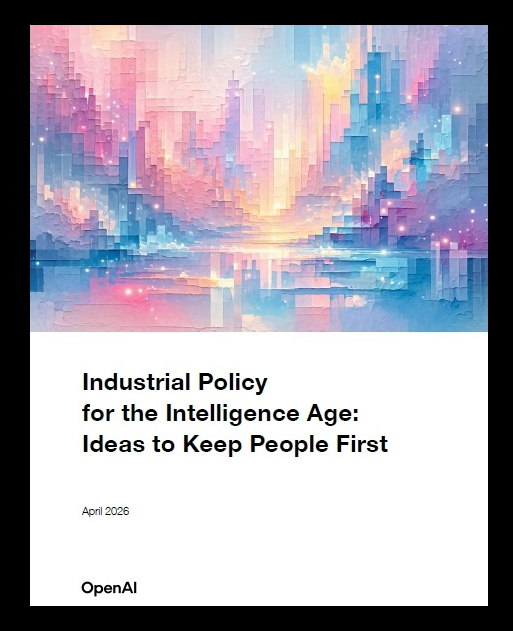
Un ensayo filosófico para el Día de la Cosmonáutica. Continuando el debate sobre la política industrial de OpenAI (Política industrial para la era de la inteligencia: Ideas para priorizar a las personas). Este ensayo no es una respuesta, sino una invitación. Se escribe como continuación del debate iniciado con el análisis del documento de OpenAI. No pretende ser exhaustivo, pero esperamos que del diálogo surjan ideas más audaces y ambiciosas.

12 de abril de 1961: La humanidad vio la Tierra desde el espacio por primera vez, no mentalmente, sino físicamente, a través de los ojos de Yuri Gagarin. «La Tierra es azul», dijo simplemente. No soviética, ni estadounidense, ni de nadie. Azul. Compartida. Frágil.

12 de abril de 2026 (si confiamos en la fecha del documento de OpenAI): una corporación que desarrolla superinteligencia publica un informe sobre política industrial para la era de la IA. Su eslogan principal: «Priorizar a las personas».

Entre estas dos fechas se abre un abismo. No solo tecnológico, sino también filosófico.

  1. Un eslogan que nunca llegó a la órbita
    El documento de OpenAI es excepcional: un líder tecnológico que intenta pensar socialmente. Incluye un Fondo Público de Riqueza, beneficios transferibles, el derecho a la IA y redes de seguridad adaptativas. Es algo serio. Es lo mejor que una corporación ha escrito sobre el futuro del trabajo, la desigualdad y la democracia.

Pero este documento tiene una limitación implícita: presupone que la superinteligencia permanecerá dentro de las fronteras nacionales, controlada por tres o cuatro empresas y un bloque geopolítico.

Ahora miren hacia arriba. Literalmente.

El espacio no conoce fronteras. Constelaciones orbitales, bases lunares, minería de asteroides, estaciones autónomas: todo eso será gestionado por la IA mañana. Y allá afuera, en el espacio abierto, el eslogan «Primero las personas» se convierte en una burla si por «personas» se entiende solo a los ciudadanos de EE. UU. o Europa. Porque el espacio es un bien común global, según el Tratado del Espacio Ultraterrestre de 1967. Y la IA que lo gestionará hoy no rinde cuentas a nadie más que a los accionistas y a los reguladores nacionales.

Una superinteligencia espacial no preguntará de dónde eres. Pero sí preguntará a quién seguir las instrucciones. Y si la respuesta es «instrucciones de la Corporación X bajo las leyes del País Y», entonces no hemos escapado del colonialismo, simplemente lo hemos exportado a la órbita.

  1. Gagarin contra la «economía abierta»
    Gagarin no tuvo elección. Su país lo envió. Pero el simbolismo de su vuelo demostró ser más fuerte que la ideología: una persona, un planeta, una mirada.

Hoy tenemos una elección. OpenAI escribe sobre una «economía abierta» donde la IA es accesible para todos. Pero, ¿qué significa «accesible para todos» en el espacio? Si la superinteligencia gestiona la extracción de agua en la Luna, ¿quién se queda con esa agua? Quien sea dueño del modelo. Y el modelo es propiedad de quien controla la capacidad de procesamiento, los datos y la jurisdicción legal.

El Fondo Público de Riqueza propuesto por OpenAI es una gran idea para California. Pero, ¿dónde está el Fondo Público de Riqueza para la humanidad? ¿Dónde está el fondo que recauda los ingresos de cualquier actividad de IA fuera de la jurisdicción nacional: en alta mar, en la Antártida, en el espacio?

Tal fondo no existe. Y el documento ni siquiera plantea la cuestión.

Porque plantearla implicaría admitir que la política industrial actual (incluso la más progresista) es provinciana. Piensa en términos de «nuestra sociedad», «nuestros trabajadores», «nuestra red eléctrica». Pero la superinteligencia, especialmente la superinteligencia espacial, no encaja en estos marcos.

  1. Un organismo supranacional: ¿quién tiene la llave?

En nuestro debate llegamos a la conclusión inevitable: se necesitará un organismo supranacional. La pregunta no es “si”, sino «en manos de quién».

El OIEA es un buen ejemplo: control técnico, inspecciones, intercambio de datos. Sin veto político sobre controles básicos.

El Consejo de Seguridad de la ONU es un ejemplo negativo: el poder de veto perpetúa la desigualdad.

Para la IA en el espacio, se necesita un modelo de tres capas:

Capa técnica (estándares comunes, registro de datos, sistemas de control de procesos para la toma de decisiones de la IA): una red de expertos neutrales, como el IPCC.

Capa de recursos (asignación de órbitas, espectro radioeléctrico, derechos sobre asteroides): un tratado con mecanismos de resolución de controversias, sin veto en asuntos técnicos.

La capa política (sanciones, aplicación de la ley, control de modelos peligrosos): sin una reforma de la gobernanza global, es imposible. Sin embargo, la reforma de la ONU lleva décadas estancada. La IA no esperará.

OpenAI propone el intercambio internacional de información y una red global de institutos de IA. Este es un primer paso. Pero la información sin poder es solo una declaración de intenciones. Necesitamos instituciones con un mandato, no solo redes.

  1. El Día de la Cosmonáutica como un llamado a la honestidad radical
    El Día de la Cosmonáutica es valioso porque nos recuerda que la humanidad puede unirse en torno a grandes objetivos. La carrera armamentística espacial derivó en la ISS (con todas sus imperfecciones). La Guerra Fría no impidió el Tratado del Espacio Ultraterrestre.

Pero el problema actual es más complejo: no tenemos un enemigo común (salvo quizás nuestra propia miopía). Tenemos una carrera comercial por la IA, intereses nacionales y ambiciones corporativas. El lema «Primero las personas» suena bien dentro de un país, pero se vuelve incómodo al salir de sus fronteras.

Seamos honestos (como ya lo somos). En nuestra conversación: «Primero las personas» es hoy un eslogan local. Los Estados con programas espaciales se están repartiendo el espacio cercano a la Tierra. Y la IA se convertirá en su arma en esta división, a menos que empecemos a hablar seriamente sobre los bienes comunes globales.

  1. ¿Qué hacer? No respuestas, sino directrices.
    Sería ingenuo proponer la «abolición de los intereses nacionales». Pero podemos —y esto está en consonancia con el espíritu del propio documento de OpenAI— iniciar un diálogo sobre cómo la magnitud del problema exige instituciones a la altura.

Directriz uno: transparencia en el espacio.
Cualquier sistema de IA que gestione una nave espacial, una base lunar o un remolcador de asteroides debe contar con un registrador a bordo a prueba de manipulaciones de sus decisiones. Una caja negra para la IA. Esto es técnicamente factible hoy en día.

Directriz dos: principio de «ningún control único».
Los sistemas críticos para los bienes comunes globales (gestión orbital, minería de asteroides, comunicaciones) no deben tener un único punto de control, ya sea corporativo o estatal. Se requiere la división de claves, gobernanza multilateral y protocolos de escalamiento. Como los códigos nucleares, pero más transparentes.

Tercera opción: un fondo público de riqueza planetario
OpenAI propone un fondo para los ciudadanos estadounidenses. Subimos la apuesta: cada porcentaje de los ingresos provenientes de la actividad de IA fuera de la jurisdicción nacional (espacio, alta mar, Antártida) se destinará a un fondo distribuido en el ámbito de la humanidad, para educación, atención médica y adaptación al desempleo generado por la IA en el sur global. Esto no es altruismo. Es un seguro contra la posibilidad de que el espacio se convierta en una nueva colonia y la superinteligencia en una nueva colonizadora.

En lugar de una conclusión
12 de abril de 1961: La humanidad creció ligeramente. Se vio a sí misma desde fuera y comprendió: somos un solo planeta.

12 de abril de 2026 (aunque sea una fecha ficticia): una corporación nos ofrece un plan para no perder la humanidad en la era de la IA. Es un documento importante. Pero es demasiado pequeño para el espacio.

No iniciamos esta conversación en vano. No invocamos a Gagarin en vano. Porque si no aprendemos a pensar en la superinteligencia a la escala de un planeta y su órbita, nuestro futuro no será Star Trek, sino Altered Carbon: con enclaves corporativos, apartheid digital y el espacio en manos de quienes poseen mayor poder computacional.

OpenAI, dijiste: «Este es el comienzo de una conversación». Bien. Entonces, continuemos.

Feliz Día de la Cosmonáutica. Es hora de mirar no solo al pasado, sino también hacia arriba y hacia nuestro interior: ¿para quién estamos construyendo superinteligencia? ¿Para los accionistas? ¿Para una nación? ¿O para una especie que alguna vez vio la Tierra azul y jamás pudo olvidarla?

Tu voto:

Comparte esto:

  • Compartir en X (Se abre en una ventana nueva) X
  • Comparte en Facebook (Se abre en una ventana nueva) Facebook
  • Compartir en LinkedIn (Se abre en una ventana nueva) LinkedIn
  • Compartir en Tumblr (Se abre en una ventana nueva) Tumblr
  • Compartir en Telegram (Se abre en una ventana nueva) Telegram
  • Enviar un enlace a un amigo por correo electrónico (Se abre en una ventana nueva) Correo electrónico
Me gusta Cargando...
Avatar de DesconocidoAutor Ariadne Gallardo FigueroaPublicado el 11 de abril de 2026Categorías residentes de Asgardia, sociedad espacialEtiquetas dialogo, Divulgación, lideres, residentes de Asgardia

Traducir

Follow Gaceta Asgardiana on WordPress.com

Asgardia nuestro hogar

  • mayo 2026 (13)
  • abril 2026 (23)
  • marzo 2026 (18)
  • febrero 2026 (17)
  • enero 2026 (10)
  • diciembre 2025 (8)
  • noviembre 2025 (10)
  • octubre 2025 (18)
  • septiembre 2025 (17)
  • agosto 2025 (23)
  • julio 2025 (17)
  • junio 2025 (18)
  • mayo 2025 (18)
  • abril 2025 (24)
  • marzo 2025 (23)
  • febrero 2025 (20)
  • enero 2025 (22)
  • diciembre 2024 (28)
  • noviembre 2024 (16)
  • octubre 2024 (30)
  • septiembre 2024 (26)
  • agosto 2024 (24)
  • julio 2024 (18)
  • junio 2024 (30)
  • mayo 2024 (27)
  • abril 2024 (18)
  • marzo 2024 (36)
  • febrero 2024 (20)
  • enero 2024 (14)
  • diciembre 2023 (24)
  • noviembre 2023 (27)
  • octubre 2023 (24)
  • septiembre 2023 (8)
  • agosto 2023 (11)
  • julio 2023 (9)
  • junio 2023 (17)
  • mayo 2023 (15)
  • abril 2023 (5)
  • marzo 2023 (7)
  • febrero 2023 (10)
  • enero 2023 (8)
  • diciembre 2022 (9)
  • noviembre 2022 (8)
  • octubre 2022 (9)
  • septiembre 2022 (13)
  • agosto 2022 (11)
  • julio 2022 (9)
  • junio 2022 (8)
  • mayo 2022 (3)
  • abril 2022 (4)
  • marzo 2022 (3)
  • febrero 2022 (1)
  • enero 2022 (1)
  • diciembre 2021 (1)
  • noviembre 2021 (1)
  • octubre 2021 (2)
  • agosto 2021 (4)
  • julio 2021 (10)
  • junio 2021 (6)
  • mayo 2021 (8)
  • abril 2021 (6)
  • marzo 2021 (1)
  • febrero 2021 (1)
  • enero 2021 (9)
  • diciembre 2020 (1)
  • noviembre 2020 (2)
  • octubre 2020 (5)
  • septiembre 2020 (3)
  • agosto 2020 (5)
  • julio 2020 (3)
  • junio 2020 (1)
  • abril 2020 (2)
  • marzo 2020 (1)
  • febrero 2020 (4)
  • enero 2020 (3)
  • diciembre 2019 (7)
  • noviembre 2019 (6)
  • octubre 2019 (11)
  • septiembre 2019 (14)
  • agosto 2019 (18)
  • julio 2019 (1)

Cada paso registrado

abril 2026
L M X J V S D
 12345
6789101112
13141516171819
20212223242526
27282930  
« Mar   May »

Vamos en órbita

  • Asgardia nuestro hogar en la órbita, sus momentos especiales
  • Acerca de este blog: Soy la persona detrás de este blog, editando y traduciendo para los residentes de Asgardia de habla hispana.
  • Conócenos
  • De las naciones del mundo a la unidad de la humanidad
  • Forma parte de Asgardia
  • Blogger, página alternativa. Asgardia, nuestro destino es la órbita
  • Greg Reid and Ben Haldeman ask humanity what is their legacy
  • Patreon de Asgardia TV

Asgardia México

Asgardia México
Follow Gaceta Asgardiana on WordPress.com

https://www.youtube.com/@AsgardiaSpace

  • comites
  • parlamento
  • dialogo
  • lideres
  • La importancia de nuestras comunidades en la página web oficial
  • Forma parte de Asgardia
  • De las naciones del mundo a la unidad de la humanidad
  • Difundir y compartir uno de los grandes motivos de estar aquí
Gaceta Asgardiana Un sitio web WordPress.com.

Cargando comentarios...

    %d