They all form a compelling and clear team. Observing from a distance is not easy, but it is essential and attractive for analysing possible habitable worlds in the future.
Remember that Ariel is a European Space Agency (ESA) space mission dedicated to the study of exoplanets. Its name comes from the acronym Atmospheric Remote-sensing Infrared Exoplanet Large-survey.
They have sent their monthly newsletter of their activities, and I am pleased to share it with you.
Ariel aims to analyse the chemical composition and thermal structure of approximately 1,000 exoplanets using observations in visible and infrared wavelengths. This allows scientists to better understand how planets form and evolve, as well as the influence of their stars on their development.

Dear ExoClock participants, I hope you are all doing well!
We would also like to welcome the new members!
We send out a newsletter like this every month, while you can read the past newsletters, watch the past meetings, and have access to other educational material at:
http://www.exoclock.space/users/material
We organise meetings dedicated to new ExoClock members. These meetings are held just after our regular monthly meeting. The beginner’s meeting is usually held on a Friday, one or two weeks after the monthly meetings. In these meetings, newcomers can ask questions of any level related to the operation of the website, observations of transits, data analysis etc. Note that these meetings are not recorded.
Finally, we have a Slack channel for more direct communication and if you would like to join, follow this link: https://join.slack.com/t/exoclock/shared_invite/zt-1t5l875v6-x0s8s553kT8nbCvbyo7boA
In this newsletter, we discuss:
1. Announcements
1.1. New HOPS manual released
1.2. Next ExoClock publication
1.3. Fifth Annual ExoClock meeting
1.4. EPSC – DPS Joint Meeting 2025
1.5. Synchronous observations campaign
2. ExoClock in the class
3. Data analysis “Removing outliers in data analysis”
4. Ariel Payload status update
1
1. Announcements
1.1 New HOPS manual released

We’re pleased to announce the release of the latest manual for the HOPS software. This comprehensive guide covers every step of data analysis using HOPS, with detailed explanations for each part of the process. You can access the new manual on the ExoWorlds Spies website:
https://www.exoworldsspies.com/en/software/
Special thanks to Panagiotis Batsela, member of the literature team, for her effort in testing HOPS and helping us to update the manual!
1.2 Next ExoClock publication
We are ready to submit our latest publication
ExoClock Project IV: A Homogeneous Catalogue of 620 Exoplanet Ephemerides for the Ariel Space Mission
This paper incorporates around 30,000 data points to update the ephemeris for 620 exoplanet targets that Ariel will observe.
The extensive analysis strongly suggested that about 45% of these targets needed updates, which is crucial for the mission’s success.
This work highlights the important role of the Ephemerides Working Group and the impact of your contributions to ExoClock in making the Ariel mission as efficient as possible.
Thank you everyone for having taken action and to those that have sent us your comments! Presently, we are collecting all co-authors’ approval to be able to submit the paper soon.
If you are a co-author, you have received emails with details, please respond and act by singing the approval box, it is mandatory to get this before the submission.
1.3 Fifth Annual ExoClock Meeting
As many of you know, every year since 2021, we have been hosting our annual ExoClock meeting in a hybrid format at various locations across Europe.
2
This event is a fantastic opportunity for the ExoClock community to come together, connect with other members, Ariel scientists, deepen our understanding of the project and the mission, and of course, have fun.
Last year, we had a wonderful time in Lisbon. It was particularly special because it coincided with the Ariel consortium meeting, allowing many Ariel scientists to engage directly with our community. The synergy was so beneficial that we are eager to replicate this experience in future gatherings.
Looking ahead to this year, we are currently considering several potential locations for our next meeting, including Madrid, Spain, and Florence, Italy. Your input is invaluable to us, and we encourage you to let us know your thoughts by filling in the following survey:
https://docs.google.com/forms/d/e/1FAIpQLScVDzPdJKdEBD0dSSoOB1_W04mBfXi6HDbAhpQ5 3bAg3V7FVg/view form
1.4 EPSC — DPS Joint Meeting 2025

The Euro planet Science Congress (EPSC), Europe’s largest conference for planetary sciences, together with the Division for Planetary Sciences (DPS) will host a joint meeting. This event will take place in Helsinki, Finland, from 7 to 12 September 2025. The conference aims to bring together people from different backgrounds, engaged in planetary science and missions, fostering scientific discussions, interactions, and networking opportunities.
This year, we are excited to host a session dedicated to Open Science:
Session ODAA6 – “Open Planetary Science for Effective Knowledge Co-Creation and dissemination”
https://meetingorganizer.copernicus.org/EPSC-DPS2025/session/55163
We invite researchers, students, amateur astronomers and citizen scientists to share new projects and developments of previous ones, in the context of promoting open and public science.
If you’re interested in presenting, please submit an abstract for your project. We look forward to an engaging exchange of ideas and would be delighted to see your contributions.
Please spread the word about this opportunity within your networks and relevant communities! The deadline to submit your abstract is Wednesday, 7th May 2025.
3
1.5 Synchronous observations campaign
Synchronous Observations are used to study simultaneously transit observations of challenging exoplanet targets to increase the S/N. These are often cases where single-site observations may be insufficient due to low signal-to-noise ratios, long transit durations, or other observational difficulties.
By observing the same transit from multiple locations at the same time, we ensure better coverage and data reliability, helping to confirm transits and refine ephemeris for otherwise hard-to characterize systems. This month, we are organising a campaign for TOI- 5704b:
• The transit event happens on the 6th of May, 20:24 UTC to 00:54 UTC. • It is an alert target that we would like to track and a good chance to explore the synchronous technique
• Use a red photometric filter, a luminance filter, or no filter at all join the campaign if you have a telescope of 8 inch (ca. 20 centimetres) and above!
Remember that the transit event will not appear in your scheduler! To check whether the transit is observable from your location and the exact time, please consider using the ex-worlds-spies scheduler at:
https://www.exoworldsspies.com/en/scheduler/
You have to indicate a telescope of 30 inches (0.76 m), and otherwise it will not appear.
If you manage to observe the transit, please submit the light curve as usually to ExoClock and include to the section of comments: “This is part of the synchronous campaign”.
We will also send you a reminder closer to the date!
2. ExoClock in the class
We’ve often showcased how ExoClock serves as a perfect example of a hands-on project for students eager to learn about exoplanets. High school students are proving that the project isn’t limited to higher education. They get to experience modern astronomy first-hand, sparking both fun and inspiration as they consider their future careers.
For the third consecutive year, Adrian Jones, an active ExoClock observer and member of the review team, has led a remarkable project at Newland Girls’ School for their 12th-grade class. The students used two datasets for their study—one from Adrian and another data set from Yves Jongen, who both generously provided observing time.
The project turned out to be a gigantic success, resulting in two transit observations being published in the school’s name. To date, the school has contributed six observations to the ExoClock project. This initiative enhances their learning and contributes data to ExoClock. These are also the highlighted observations for this time!

4

3. Data analysis “Removing outliers in data analysis”
When analysing data with HOPS, it’s important to be cautious about manually removing outliers. While it might be tempting to delete data points to achieve cleaner light curves, this practice can lead to more harm than good from a statistical standpoint. Manually removing outliers can introduce bias, skewing the results.
It’s essential to understand that the observations we deal with often contain red noise, unlike pure Gaussian or white noise. Red noise includes systematic patterns, such as small bumps, which are usually related to equipment issues or weather conditions. When red noise is present, removing 3- sigma outliers isn’t advisable because it means clipping the distribution and possibly discarding valid data that reflects underlying phenomena, even if they aren’t the astrophysical signals we’re targeting.
Rather than removing outliers based solely on visual inspection of light curves, it’s more appropriate to evaluate the original frames. If certain frames are compromised by factors such as cloud interference, street lights, or inadequate guiding, then those frames should indeed be removed. By focusing on the quality of frames rather than the light curves, you prevent the introduction of manual biases and preserve the integrity of the data.
5
4. Ariel payload status update
by Salma Fahmy, Ariel Mission Payload & AIV Manager:
The development of the Ariel spacecraft continues to proceed well.
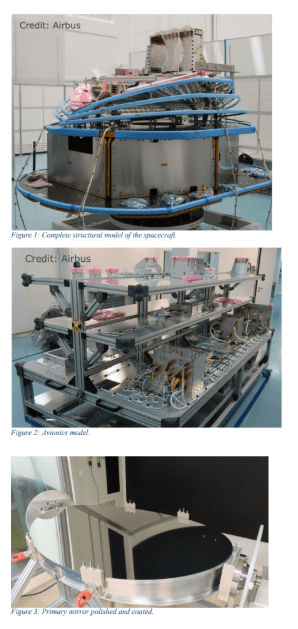
A major milestone was achieved at the end of 2024 with the testing of the spacecraft Structural Model, which is a fully mechanically representative model of the spacecraft (see image 1, next page). It was successfully subjected to vibration testing to demonstrate that it can survive the launch!
This model also allowed a dry run of the integration and alignment of the payload with the spacecraft Service Module, which went smoothly. The results of the tests are being analysed and used to correlate and update the Finite Element Model of the spacecraft to improve its fidelity.
In parallel to this, the Avionics Model, which will be used to test the data handling and electrical functioning of the spacecraft, is gradually being put together. The Onboard Computer is the first unit to have been delivered to Airbus in Toulouse. All the cabling has also been built. The payload units are being built and planned to be delivered in June this year. Preliminary models of the Instrument Control Unit, the Detector Control Unit, and the Telescope Control Unit are currently being tested together by the payload teams. This allows to verify that these electronic units can correctly communicate with each other before they are all delivered to Airbus for the avionics test bench. Image 2 shows the Avionics Test Bench at the S/C Prime’s premises in Toulouse.
Meanwhile, on the telescope, all mirrors for both the Structural and Engineering models have been manufactured, polished and coated (see image 3 for the primary mirror). All the telescope structural elements have also been manufactured and will now have the surface finishes (black coating) applied before the assembly of the telescope Engineering Model starts.
Instrument teams are also busy preparing for their Critical Design Reviews, which will be held during this year. Once these reviews are successfully concluded, it will give the green light for manufacturing of the remaining Flight Model parts!
In the next page you can find some photos demonstrating the progress of the spacecraft development!
You can watch Salma talking in the following link, which was featured in the consortium meeting in Lisbon.
Clear Skies,
the ExoClock team